

Archive: this page shows a past KLEMENTZ build. We no longer make these machines or custom units. Today we design the KLEMENTZ Dub Mixer, and a stereo 4U preamp is on a waiting list.
This was our 1U Preamp / Isolator / 4-way stereo filter.
We have designed this machine to be compact and yet as complete as possible!➡ SEE THE ARCHIVED PRODUCT PAGE ⬅
Entirely Stereo, in 1U Rack format, it features the following functions :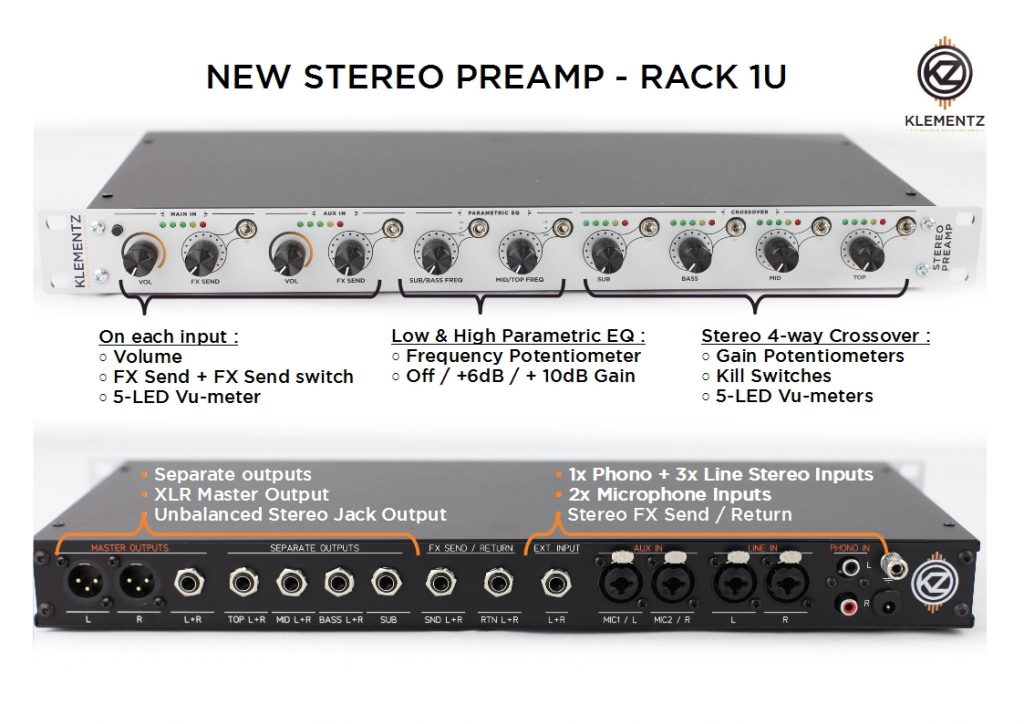 – 2x Volume and Effect Sends (with On/Off switches for the FX send)– 2x Parametric Equalizers with Frequency and Gain Setting (Sub/Bass et Mid/Top)– 4-Way Stereo Active-Filtre with Phase re-aligment (with volume and kills) [the kill switches only works on the Main input]– 1x Stereo Phono Input– 3x Stereo Line Inputs– 2x Microphone Inputs– 1x FX Return Input– 1x FX Send Output– 4x Separate Outputs of the Active-Filter (4-way Corssover)– 2x Master (Full Range) Stereo Outputs, 1 with two balanced XLR connectors and 1 with unbalanced Jack Output.
➡ SEE THE ARCHIVED PRODUCT PAGE ⬅
This 1U unit is no longer part of our catalogue. Its functions live on in the Dub Mixer, which combines the preamp, the isolator filters, the delay and the siren in a single stereo box.
For the general picture, see our guide on dub and sound system preamps.
What a rack preamp and isolator has to do
A rack unit like this one sits between your sources and your amplifiers, and it has to cover four jobs at once: bring every source to the same clean level, split the spectrum for the amplifiers, put the frequency bands under your hands, and send the effects. The specification above is one way of solving that. Here is how to read a spec sheet like it.
Isolator or EQ: not the same thing
This is the detail that separates a sound system unit from a studio one. A classic equaliser attenuates, usually by around 15 dB. An isolator goes to zero: when you pull the bass down, there is no bass left at all. That silence is the whole point of the drop, and an EQ cannot give it to you. If a spec sheet says « EQ » where you expected « isolator », check which one it really is.
The crossover, and why phase alignment appears on the spec
A 4-way active filter splits the signal into four bands, each with its own output and its own amplifier. The moment you do that, the bands have to arrive at the listener in step. That is why phase re-alignment shows up in the list above: without it, the crossover regions cancel instead of adding, and the system sounds thinner the louder it goes.
Counting inputs and outputs before you buy
- Phono or line. A turntable needs a phono stage. A media player does not, and plugging one into phono will overload it.
- Microphone inputs. One is enough for a single MC. Two if you pass the mic around.
- FX send and return. Separate send and return is what lets you play the effect by hand rather than leaving it in line.
- Master outputs. Balanced XLR for long runs, unbalanced jack for short ones. Having both saves adapters.
1U rack or compact box?
A 1U rack fits a flightcase, protects the controls in transit and lines up with the rest of your gear. The trade-off is that the controls end up small and close together, which is awkward when you are playing in the dark. A compact box gives you more room per knob and less to carry, at the cost of the rack ears. Neither is objectively better: it depends on whether the unit lives in a case or on a table.
For the broader picture on preamps, see our guide on dub and sound system preamps.
What replaced it
Preamp, 3-band isolator, delay and siren in one stereo unit under 1 kg, with a customisable FX loop.
